

Guarding the Grass: Inside Matt Bruderek’s Mission to Build Inter Miami’s Perfect Pitch. Again!

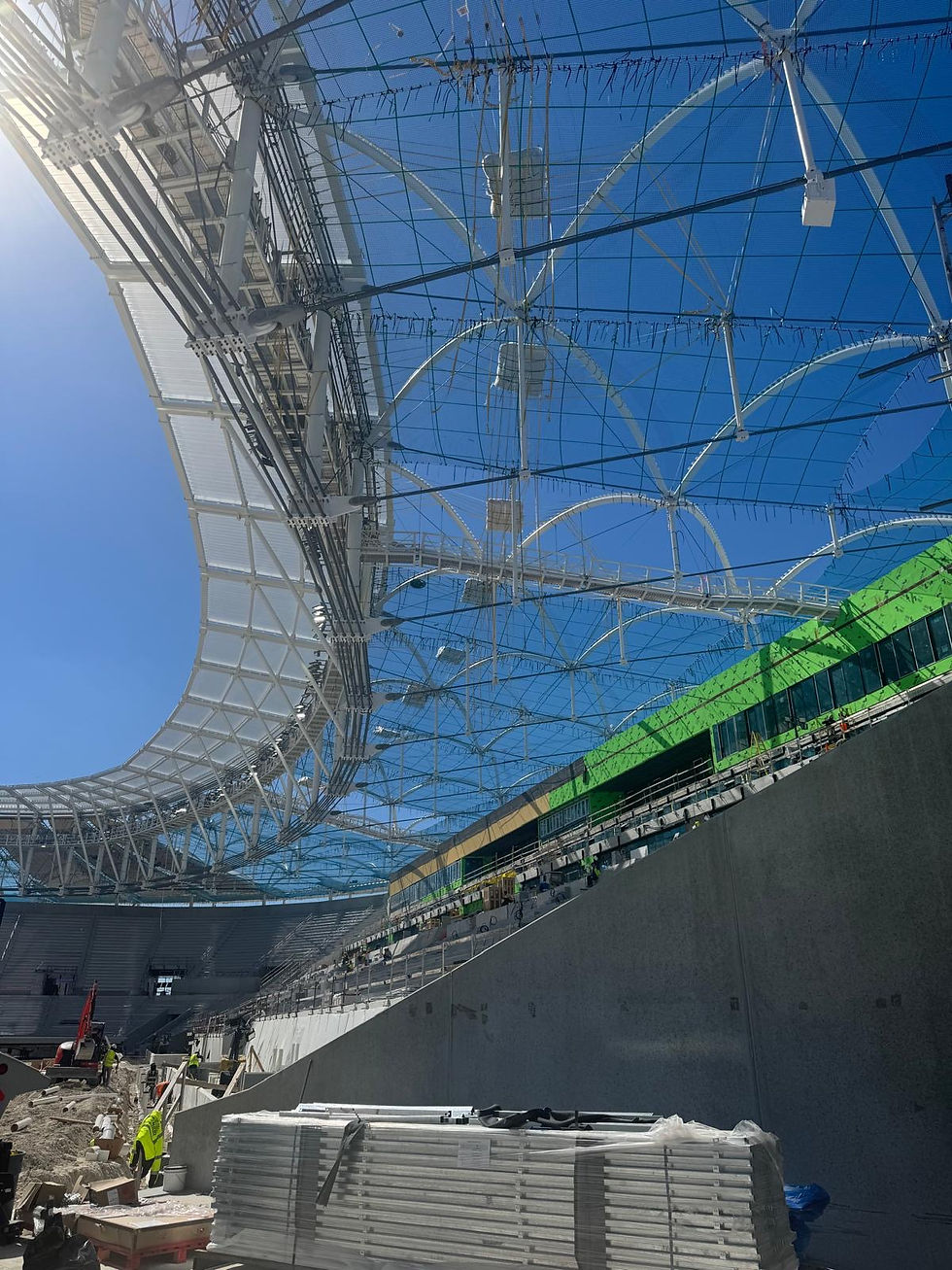
At dawn, the rising sun washes over the construction site of Inter Miami’s new stadium, casting long shadows across the half-formed bowl that will soon become one of Major League Soccer’s most modern homes. Amid the machinery, scaffold and fresh concrete, one figure moves with a deliberate calm. Hard hat on, eyes trained on the soil beneath his boots, Head Groundsman Matt Bruderek is already at work — even though, technically, his field doesn’t exist yet.
For most clubs, the story of a new stadium is told through architects, engineers, and executives. But for Matt, the story begins and ends with the grass. “We’re putting in a system that’s as advanced as anything you’ll find in the league,” he says. “This is the foundation for everything that’s going to happen on this field.”
This is the tale of a playing surface being engineered from the ground up, in both the literal and human sense, and the man responsible for making it grow.

A Stadium Built for the Future, From the Soil Up
Inter Miami’s new 25,000 seat stadium is due to open with a pitch designed for durability, versatility and elite performance. While fans will see the sweeping stands, retractable Northend seating and concert-ready platforms, the most important engineering is buried several feet below the surface — in a precise, layered ecosystem Matt helped shape.
“We’re putting in a full pitch ventilation system,” he explains, referencing the vacuum pressure technology used in some of the world’s top stadiums. Beneath the grass will sit a drainage network spaced roughly 15–20 feet apart, all funnelling into a collector system that exits the North end of the field. On top of that: a four-inch gravel layer, then a 12 inch USGA spec sand profile.

It’s a controlled environment for a notoriously uncontrollable climate.
“Down here you can get an inch of rain a day for a week straight,” he says. “Sometimes you just can’t control how much you’re getting. SubAir lets us take back some of that control.”
Above ground, the grow light and air movement strategy was designed with equal ambition. Shade studies conducted with Grow Lighting – LED Technology to a meticulously planned electrical and storage layout for a fleet of 9 x Large Rigs, 2 x Small Rigs, smaller spot units and a large number of turf fans — all of which Matt will use to combat one of Miami’s most underestimated challenges: shade.
“The whole South end of the field will be blocked during the winter months,” he explains. “It’s a completely different environment than what we’re used to. We needed the right tools.”
The Grass Beneath the Badge
Officially, the surface will be Tifway 419 Bermuda, brought in from a trusted supplier who’s been cultivating the sod on plastic sheeting for us.
“It’s been growing for us for twelve months,” Matt says. “He gets the sod, puts it on plastic, and just top dresses the hell out of it. It’s as good as you can get for this climate.”
The sod will be installed around March 10 — about three weeks before the first match.
“Not much time, I know”.
But Matt likes the challenge.
“We’ll have just enough time to mess around with it, tighten it up and get it where it needs to be.”
The decision to source locally was ultimately driven by climate, common sense and practicality. “It didn’t make any sense to ship thick cut sod from North Carolina or Alabama. We have a great farm an hour and a half from here. Using the grass they grow, made everything easier.”

Weather, Water and the Art of Keeping Bermuda Honest
If Florida is a paradise for Bermuda grass, it is certainly an unpredictable one. Heat, humidity and nonstop moisture can make the turf thrive or suffocate — sometimes on the same day.
“It’s the muggy, moist, constant rain,” Matt says. “That’s the biggest challenge.”
Disease pressure usually hits below the surface — fast spreading rootzone pathogens, subsurface stress, and occasional outbreaks inherited from regional environmental conditions. “We don’t see much leaf disease. It’s mostly what’s happening underneath,” he explains.
The irrigation water doesn’t help. High salts, high bicarbonates, high iron. It leaves stains on concrete, strips colour from leaf tips and requires constant chemical management.
“You’ll see a heavy rain and suddenly everything looks different,” he says. “It’s that
dramatic.”
To combat nutrient imbalance and disease, Matt runs a preventative programme built on monthly fungicide cycles, seasonal grub control, selective wetting agents and weekly foliar applications that lean toward gentle, spoon-fed growth rather than aggressive nitrogen pushes.
“In the summer, if you’re too aggressive with nitrogen, it just puffs through all the regulators,” Matt says. “You wind up creating more problems than you solve.”
The Science (and Stress) of Growth Regulation
Ask any groundsman their greatest challenge and you’ll hear a range of obstacles: traffic, drainage, weather. Ask Matt, and the answer is more specific.
“The toughest part of the year is always those first Primo applications,” he says of the growth regulator used to control the Bermuda’s tendency to grow too fast and too “puffy.”
Everything depends on the timing — the heat, the humidity, the soil temperature and the “stacking effect,” where the early applications set the tone for the season.
“It’s almost better to go earlier and lighter,” he says. “If you put that first application down too late, and you’re waiting on the second, it can get away from you.”
Once the growth habit tightens and the canopy stabilises, the field enters its best form: fast, firm, true. “Playability over presentation,” Matt says. “That’s always the priority”.
Mowing Patterns and the Subtle Battle for Playability
While fans may not notice the specifics, mowing patterns are an art — and a strategic choice. MLS mandates an East to West pattern visible on broadcasts, with stripes aligned to penalty boxes, six-yard boxes and the centre circle.
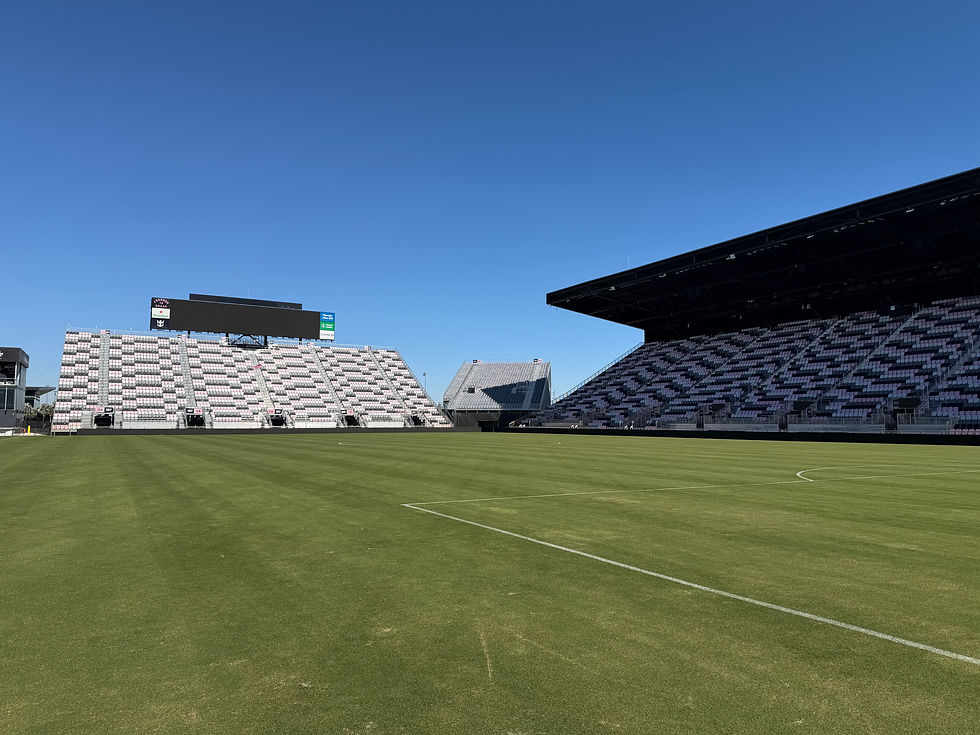
But in Miami, Bermuda’s natural growth habit, the stadium’s shade patterns and the nightly use of grow lights all work against clean, sharp striping.
“With the low height and the amount of leaf blade we have, it never pops like ryegrass,” Matt says. “Night games drown it out even more.”
Last season, when the grass was growing too horizontally, Matt pivoted. He abandoned some of the presentation focused patterns and shifted to North–South and angled cuts to combat layover and improve ball roll.
“We sacrificed a bit of presentation for playability,” he says. “And the field was better for it.”
Two Facilities, One Team, and a Role That Stretches for Miles.
The new stadium isn’t Matt’s only responsibility. The training complex, built between late 2019 and early 2020, includes six full-size natural grass fields, a 19,000-seat (now ~20,000) stadium used for temporary MLS play, and an artificial turf field for local events. All follow identical construction profiles to the new stadium, minus SubAir.
“We maintain about seventeen acres of grass,” he says. “It’s a big site.”

And the manpower?
“It’s me and five guys right now,” he says. Once the new stadium opens, that will expand — but only slightly. “People underestimate how tough it is to recruit for this. It’s hot, it’s humid, and the schedule is demanding.”
His day starts at 6.30am. Most days feel like a race against the weather. “If rain’s coming at one or two o’clock, you’re sprinting to get things done.”

Building a Pitch for All Seasons, All Sports
Although built for Inter Miami, the stadium is designed for multisport and multievent use from the outset. Rugby sleeves and American football markings are already accounted for. Retractable seating at the North stand can shift backward to create a wide platform for major concerts.
“It’s a good space,” Matt says. “It’ll probably extend into the six-yard box a little bit, but that’s a lot better than damaging the whole eighteen.”
Field protection systems will be hired at first, with the possibility of a club owned system later.
“We’re going to be doing a ton of events — concerts especially,” he says. “It makes sense to have the right tools.”
World Cup involvement was never realistically on the table; FIFA could not rely on a stadium not yet built during the planning phase. Instead, the club will host watch parties and community events.
The Sod Story, the Countdown Clock, and the Human Weight of Responsibility
Sod installation marks the moment a stadium stops being a construction site and starts becoming a home. For Matt, it represents the culmination of years of planning, site meetings, shade studies, irrigation layouts, SubAir schematics, and endless technical compromises.
The sod arrives in early March. The first match is in early April.
Three weeks.
But when he talks about it, Matt smiles.
“We’ll get it dialled in,” he says. “We always do.”
There is no drama in his voice, but there is gravity. Because for all the technology humming beneath the pitch — the pipes, pumps, sensors, fans, robots, grow lights and someone who knows the grass intimately.
“We’re building something that can host anything,” he says. “Soccer, football, rugby, concerts — whatever comes our way. We want the field to be ready for all of it.”
And as the stadium rises around him, steel by steel and seat by seat, Matt walks the site each morning, studying angles of sun, moisture in the soil, and the places where the pitch will soon breathe.
Because when the stadium finally opens, no one will think about the gravel layer, the pitch ventilation ducts, the quality of irrigation water or the art of timed Primo applications.
But Matt will. He always will.

