

Celtic Park: A Year of Renewal and a Lifetime of Dedication
Updated: Apr 17

From a technical perspective, Celtic Park presents one of Scotland’s most difficult stadium pitch challenges. At a 60,000-plus capacity, a Northerly location, and a team that ‘generally’ produces a high number of home fixtures, all combined with a stadium training culture for peak winter periods, it can be a deadly combination for sustained turf coverage.
To accompany this, the stadium pitch had previously required thick-cut stitched turf, which affected root development (subsequently, shade tolerance), retained higher-than-desired moisture, and caused infiltration to be slower than required during the winter months. All during a period where the club sought higher standards while inflicting increased use and expectation of the pitch. Paradoxically, achievable standards and expectations drifted further apart over half a decade until the pitch was prioritised.

Over the past year, the Celtic Park pitch has undergone one of the most significant periods of redevelopment in its modern history—work overseen and guided by the club’s long-serving Head Groundsman, John Hayes. The 2025 off-season marked a turning point, with extensive reconstruction designed to future-proof the pitch against the demands of elite football, congested winter fixtures, and an increasingly unforgiving climate.
The process began with the complete removal of the old surface, allowing John and his team, led by SIS Grass contractors and supported by OBI Sports, to implement the pitch rebuilt from the lower rootzone up. An innovative, tighter hybrid stitching pattern was introduced, giving the pitch far greater surface & root stability, resilience, and a much better draining capacity. The early results have been impressive: stronger root structures, improved consistency under pressure, and a pitch that has endured the winter schedule better than any season in recent memory.
Lighting was another central focus of the upgrades. Celtic invested in three additional SGL lighting units, bringing the total to nine SGL 440s and three SGL 120s, dramatically increasing the club’s ability to accelerate growth and recovery during short daylight hours. These enhancements required a considerable expansion of the stadium’s electrical infrastructure, with new power supplies and cabling installed along the stand track.
With lighting now in almost constant operation—often seven days a week—the labour demands naturally increased. Although the club was not seeking to expand its full-time staffing, Hayes introduced a flexible model, bringing in trained casual workers to reposition lighting rigs and support match-to-match maintenance and recovery. This adaptive approach has allowed Celtic Park to manage intensive winter training blocks, while still presenting a world-class playing surface on matchdays.
According to John, the objective behind these investments was clear: to improve durability, enhance winter-training tolerance, and deliver a reliable, top-quality‑ surface regardless of fixture congestion. “It’s been achieved,” he reflects. “You can see the condition of the pitch now—everybody’s happy at the football club, and that is no easy achievement.”

John Hayes: A Career Rooted in Celtic Park
While the recent reconstruction and investment have been transformative, they represent just one chapter in John Hayes’ nearly five decades at Celtic Football Club—a journey that began in June 1978 in circumstances far more modest. John is a professional who has had to transform himself and work with teams, multiple times throughout his career. Someone who can do that is special; that takes a rare personality who puts their ego and past presumptions aside to change, evolve and better themselves.
Hayes joined Celtic through a job creation and work experience programme, originally intended to last six months as a youngster. After only three months, a member of the grounds team left, and Hayes stepped into the role of groundsman assistant at the time. That moment marked the beginning of a career that has now reached 48 years, making him one of the club’s (if not the industry's) longest serving figures. John's name is one that, when mentioned around the industry, is met with smiles and nods of respect. For those of you who know a little more about John, this is not a man born into entitlement, privilege, or advantages; his success and stability in life, for which he will always be grateful to his devoted wife, Tricia, are very much earned through grit and perseverance.
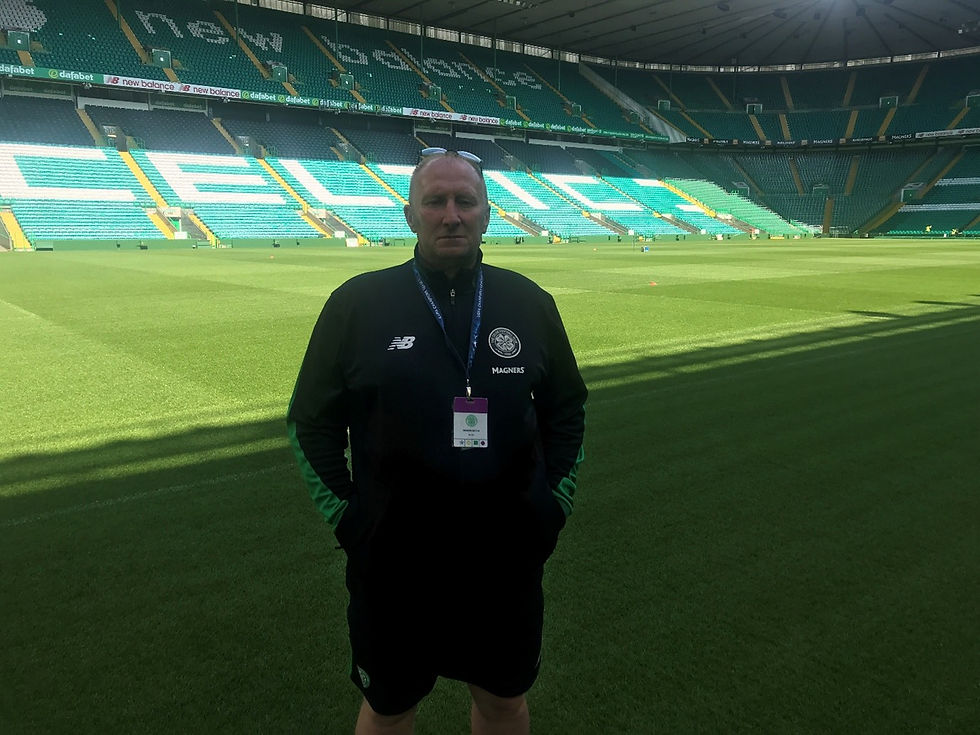
Much of John’s development came through hands-on learning and guidance from experienced groundsmen such as Jock Armstrong, Billy Elwood and Geoff Brereton. He absorbed everything: fertiliser management, turf nutrition, machinery operation, management of drainage, and long-term maintenance planning. His dedication and growing expertise eventually led Celtic to entrust him with primary responsibility for the Celtic Park pitch, initially on a six-month trial, which was more than 25 years ago. The trial was a success—and he never looked back.
Over the years, John has witnessed a dramatic evolution in football and groundskeeping. Gone are the days of heavy black loamy soil pitches; the modern game demands hybrid systems, advanced drainage, precision technology, and near-perfect playing surfaces year-round. Television schedules have tightened preparation windows, with late kick-offs and shorter recovery periods creating new pressures on upkeep. Winter fixture congestion has grown, especially since mid-season breaks were removed, forcing Haynes' team to protect and present the pitch under increasingly demanding conditions.
Yet through every shift in the sport, John has adapted, innovated, and led. His stewardship has helped Celtic Park remain one of the most respected stadium surfaces in British football.
A Legacy of Commitment Today, with the Celtic Park Pitch revitalised through John's ongoing ability to evolve and change, and major reconstruction and enhanced lighting infrastructure, John stands at the centre of both the club’s past and the foundations of its future.

His partnership with contractors, consultants, temporary labour teams, and club leadership has produced a surface capable of meeting the highest modern expectations. What has stood out most is that everyone around John wants to see him succeed. I believe this is because they can see his unwavering commitment to the club and his desire to deliver, so they give up time and resources to support him.
Nearly five decades after arriving at Celtic on a temporary placement, John Hayes continues to devote himself to the pitch he has helped shape—one season, one upgrade, and one match at a time. His story is not only about turf management; it is about longevity, quiet excellence, and unwavering commitment to Celtic Football Club.


