

From the Bottom of the League Table to the Top: Ipswich Town’s Remarkable Pitch Revolution

By Ben Connell, Grounds Manager, Ipswich Town FC
When Gamechanger 20 completed its purchase of Ipswich Town Football Club in June 2021, attention quickly turned to more than just football operations. A comprehensive review of the club’s facilities highlighted significant opportunities for improvement, particularly in the quality and resilience of the playing surfaces at both Portman Road and the training ground.
What followed was one of the most ambitious infrastructure projects in the club’s history: the transformation of every major playing surface while maintaining daily football operations and preparing for a new era of growth.
Establishing the Benchmark
Before work could begin, Ipswich needed to understand exactly where it stood among its peers.
Working alongside OBI, Hewitt Sportsturf and a network of grounds professionals across the country, a benchmarking exercise was undertaken to assess training facilities throughout the professional game. The study examined the number of pitches available to first-team and academy programmes, construction methods, drainage provision and overall infrastructure quality.
The findings were sobering. Ipswich ranked near the bottom of the table. Unlike many rival clubs, the majority of the club’s pitches remained soil-based, with little or no installed drainage and limited modern infrastructure.
The results provided a clear roadmap: a phased four-year programme of pitch construction and redevelopment.

The First Step into Modern Construction
The first phase arrived in 2022 with the redevelopment of the club’s three first-team training pitches.
Previously, these surfaces were traditional soil-based pitches, lacking drainage systems and, in some cases, still reliant on travelling sprinklers for irrigation. The new specification introduced sand-carpet construction, primary and secondary drainage networks and a fully automated Rain Bird irrigation system.
The impact was immediate.
Winter performance improved dramatically, while consistency and reliability increased throughout the season.
Shortly afterwards, SIS stitched the pitches with synthetic fibre reinforcement, marking Ipswich Town’s first move into hybrid pitch construction.
At the time, even Portman Road had yet to adopt modern hybrid technology. The improvements delivered at the training ground provided a glimpse of what was possible.
Rebuilding Portman Road from the Ground Up
In the summer of 2023, attention shifted to the stadium itself.
Working alongside Charles Henderson & Mark Higgs, of OBI Sports and Hewitt Sportsturf, Ipswich embarked on a full reconstruction of the Portman Road pitch. The project was essential. The existing surface was one of the last non-reinforced pitches in the Football League and increasingly unable to support the fast, expansive style of football desired by the club’s management.
Architects faced a unique challenge. Portman Road’s dimensions and levels were far from conventional, requiring careful design work to ensure a modern construction could integrate seamlessly within the historic stadium.
Investigations revealed the limitations of the old surface. Decades of incremental improvements had left hundreds of tonnes of sand mixed through the native soil profile. Soil analysis showed significant percentages of fine sand and poor drainage performance, with hydraulic conductivity rates measuring only 8mm per hour.

A complete rebuild was the only realistic solution.
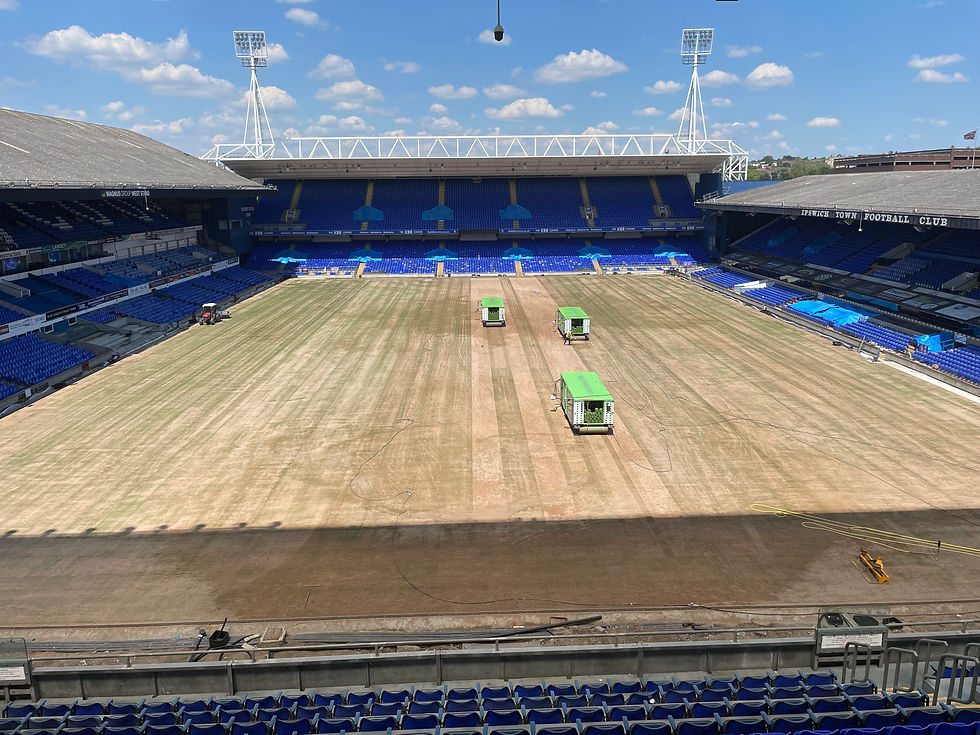
Inspired by a visit to Leicester City’s pitch construction project two years earlier, Ipswich elected to install a hybrid pitch supported by a Permavoid water attenuation system. Undersoil heating was added for the first time in the club’s history, replacing decades of dependence on frost covers.
The project also modernised vital infrastructure. New boiler facilities, irrigation systems and control rooms were incorporated into the design, replacing an ageing irrigation setup hidden beneath the North Stand and accessed through a notoriously cramped service entrance.
For the grounds team, the improvements were transformative.
Unearthing Portman Road’s Hidden History
Excavation works delivered more than engineering solutions.
Portman Road’s origins as a cricket ground built over a Victorian rubbish tip quickly became apparent as construction progressed. Beneath the existing drainage network lay another system of clay drainage pipes dating from the late 1970s. Remarkably, many appeared almost untouched by use.
Even deeper, the excavation revealed a treasure trove of Victorian artefacts.
Bottles that once contained beauty products, clay smoking pipes and numerous historical remnants emerged from the soil. Among the most memorable discoveries was a Fisons fertiliser mug, likely lost during pitch works carried out decades earlier.
One local legend, however, remained unsolved. Despite extensive excavation, the rumoured wall beneath the north-west corner of the pitch was never found.

Technology Delivers Results
Since installation, the new pitch system has exceeded expectations.
The 80mm-deep Permavoid attenuation layer creates an air-filled void beneath the surface that warms rapidly, allowing the undersoil heating system to operate efficiently. Running costs have proven significantly lower than anticipated, particularly when compared with experiences reported by other clubs.
Captured water is stored and carefully managed through an integrated drainage network before being pumped away from the stadium through an area packed with utility services affectionately described as “spaghetti junction” by the grounds team.
Establishing the new sand-based profile required considerably higher nutritional inputs than previous pitches, but once the grass matured, the benefits were unmistakable.
Post-construction testing in October 2023 recorded infiltration rates averaging 548mm per hour, a remarkable increase compared to the previous surface. Equally important, moisture management became far more predictable, allowing for more aggressive irrigation strategies without risking turf loss or excessive winter damage.
Transforming the Training Ground
By 2025, the redevelopment programme had expanded dramatically.
A new £35 million first-team building rose on the training ground, while a purpose-built grounds maintenance facility replaced temporary accommodation that had seen staff spending an entire winter working from a marquee.
Simultaneously, six academy pitches underwent full reconstruction.
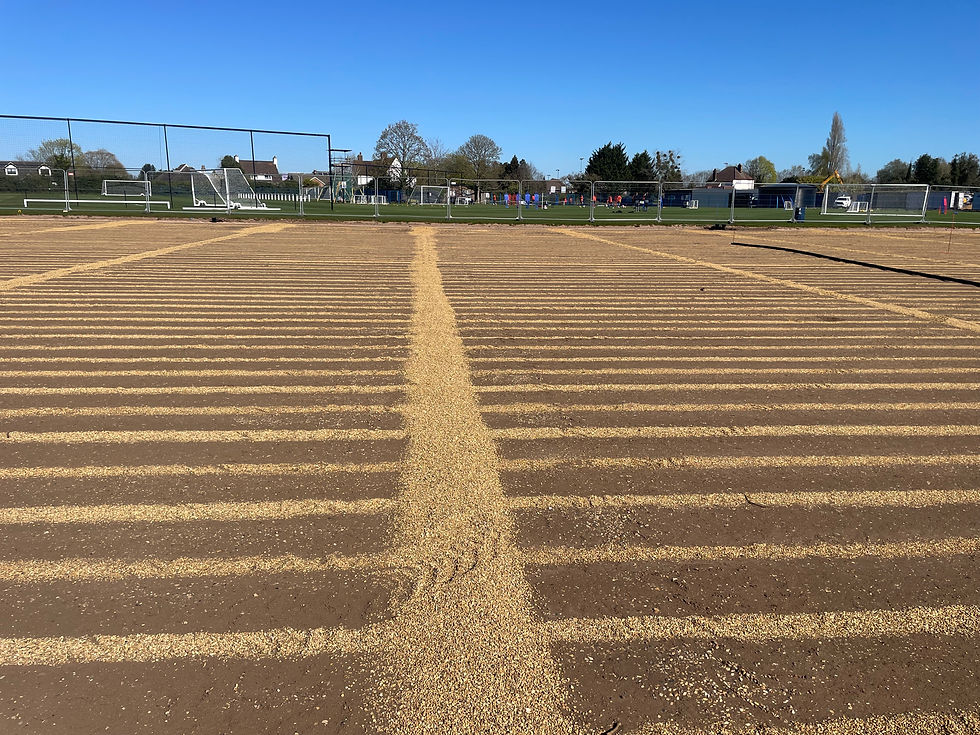
Originally conceived as Fibresand pitches, the project evolved into something more ambitious. Additional investment enabled the installation of non-gravel carpet stitched hybrid pitches complete with comprehensive drainage systems and modern Hunter irrigation technology.
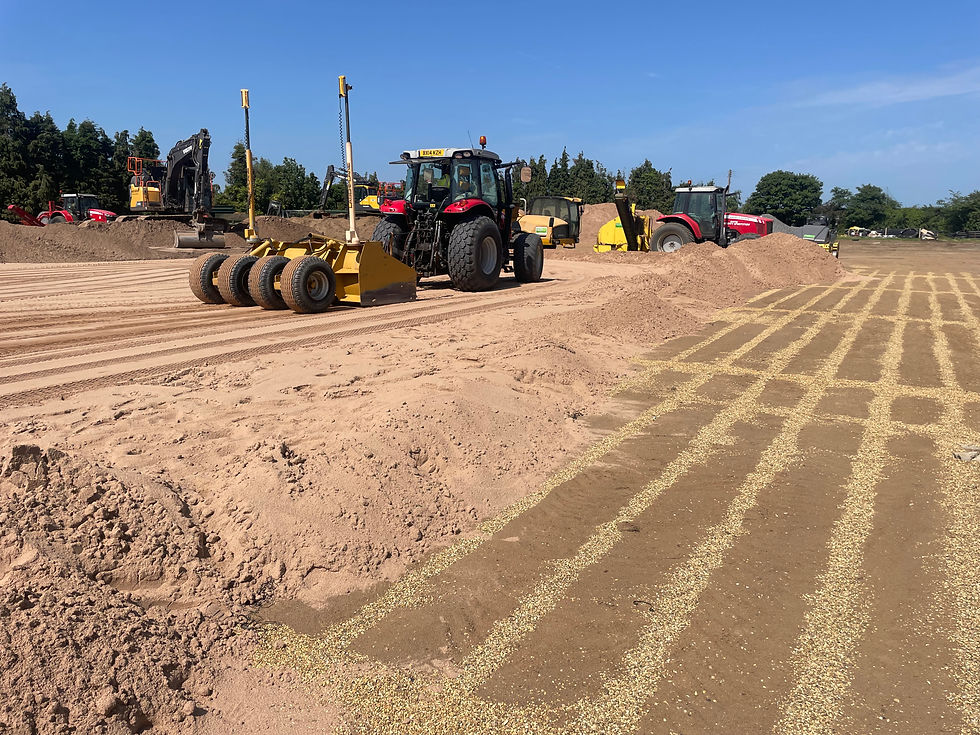
The first stage transformed four pitches on the academy’s main site, including the removal of mature conifer trees, expansion of goalkeeping areas and relocation of irrigation infrastructure. A new floodlit “show pitch” was also constructed as part of the club’s Category One academy ambitions.
Two further pitches were redeveloped at the nearby Bent Lane site.
Managing academy football throughout construction presented a considerable challenge. With programmes ranging from Under-8s through to Under-21s, alongside the Women’s teams, maintaining sufficient training space required detailed planning and flexibility.
The Bent Lane pitches established successfully following seeding in September, though consolidation issues during the first winter affected traction and durability. While visually acceptable, the surfaces struggled under regular use before improving significantly following spring overseeding and renovation works.
Despite being relatively new, the decision was taken to renovate the pitches early to address settlement and accelerate long-term performance.
By early 2026, construction had begun on the final academy pitch, bringing the total to seven newly constructed surfaces within a 12-month period.
The Final Phase
Promotion back to the Premier League in May 2026 triggered the next stage of development.
Pitch 2 at the first-team training ground was upgraded to match the specifications now used throughout the academy, returning to play by September. Attention has since turned to the final two first-team pitches, both of which are expected to receive undersoil heating as part of their redevelopment. For a grounds team previously responsible for deploying frost covers across multiple pitches, the prospect of heated training surfaces represents a significant operational advantage.
Looking ahead, innovations such as subsurface irrigation are already being considered. With increasing disease pressures and reduced fungicide availability across the industry, new technologies continue to shape the future of modern sports turf management.

A Transformation Years in the Making
In just five years, Ipswich Town has undergone a complete transformation of its playing infrastructure.
What began as a benchmarking exercise that placed the club near the bottom of its peer group has evolved into one of the most comprehensive pitch development programmes in British football. Every academy and first-team pitch is now a stitched hybrid construction, delivering levels of consistency, durability and performance that were once unimaginable.
For a project that started with a recognition of how far there was to go, it represents an extraordinary achievement and a clear demonstration of what can be accomplished when long-term vision is matched by investment and commitment.

